back | cv | article | Artikel (auf Deutsch) | article in Russian | article in Dutch | publications | art book
From the book 'Olga Okuneva. Painting. Graphics', 2014:
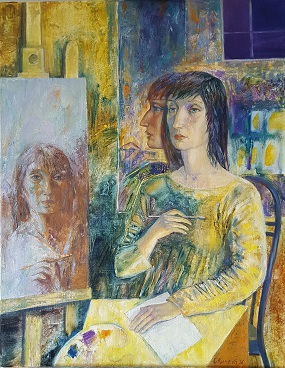
The main advantage of this creative process is that it does not let her stray from her chosen path but leads her towards the Ocean in search of perfection.
Olga Okuneva was born in the small provincial town of Otradny, in the Kuibyshev region of Russia. When she was eight years old, she moved to Orenburg. She attended a children’s school of arts. Then, against her parents’ will, she entered a College of Arts and later continued her education at the Graphics Department of Kharkov Academy of Design and Arts (KhADA). She made her own choices and has steered a steady course ever since. On our life journey we meet individuals who have a great impact on our personalities. Touching with the spiritual essence of such persons can greatly accelerate our own life progression.
In the years of her studies Olga Okuneva met a prodigy graphic artist Stanislav Kosenkov. This man possessed an extraordinary gift of creativity as well as a talent for teaching. Olga used to visit him at Belgorod city to show him her sketches, illustrations, drawings; they had tea together and she listened to stories from his life and stories about artists. When she returned home, she became aware of the fact that he had been talking for the whole time about her works, about herself and that he had been setting her a task 'to express an idea, to convey a message, to create an image — by all means possible'.
Fresh out of the institute she worked at the All-Union Artists’ House Senezh and at the House of Russian Graphic Arts, The Chelyuskinskaya. Both places were considered to be “the highest schools” for any young artist. The best creative powers of Russia were concentrated there. Okuneva did not have her own print studio and she spent numerous months at the Chelyuskinskaya working on graphic cycles, trying lithography, monotyping — all possible techniques. Olga was lucky to belong to the last generation which was educated in such an environment, which offered them a creative workshop, a laboratory for their experiments. The turning period of the 1990s came, things changed greatly. One stay at the Chelyuskinskaya and one cadence at Senezh sufficed for Okuneva to find her own way, to start her creative activities.
Etching was her first love. She did not choose it. It came about itself, from as far back as her studies at the Academy. The etching technique fitted precisely the inwardness of the young artist. It is an elite technique which is capable of rendering all human senses and states of interpersonal relations; it is capable of suspending time and capturing the present moment.
The etching technique allows for the creation of fine and soft works or, on the contrary, explosive and expressive ones, whether they exhibit the character of sketches or are refined to the state of a perfectly finished image. She took great delight in producing expressiveness and loftiness, monochromous colourful harmonies and richness of shades of grey — out of black paint. It is a technique of mavericks. One is not dependant on a printer as in lithography. For such a self-sufficient person as Okuneva, this feature was very important.
Etching was a miraculous gift for Olga. Etching is a technique of doing many operations, so the more you work on a metal plate, the farther you can deviate from the original idea. You can never predict the outcome of the work on the plate in the form of an etching printed on paper. Right up to the moment when the first print is made and the sheet is lifted, one is kept on a knife edge waiting for the results of his or her work. The feeling experienced by the artist at that instance is incomparable.
Olga worked with dedication, ecstatically. Within a short period the following cycles were created: ‘The Circus Has Come’ (1989), ‘Arrival of the Birds’ (1989), ‘Strolls about the Park’ (1990), “View from the Window’ (1992), ‘Colour Dreams” (1993). Her world of Perestroika Russia of the 1990s, of the period of painful social reforms is unstable, vulnerable, irritable and fragile, yet it is intriguing to open the window and to be footloose and fancy free, to dissolve and to live a life created by one’s fantasy.
She stayed in the grip of etching; it did not give her an opportunity to do anything else. Such dedication and respect to the technique bore fruit. Okuneva started to take an active part in exhibitions. Art critics took notice of her, she found her own admirers. In 1990 she became a member of the professional Union of Artists of Russia. At age of 39 Olga Okuneva was awarded the high government distinction ‘Honorary Artist of Russia’, and she is one of the youngest artists in Russia this title was conferred on. The sensation of miraculous discovery animated her work for a long time. At a later stage Olga achieved full freedom in the techniques and she could predict the result a hundred moves ahead.
Drawing has always been her strong point. Her student charcoal, pencil and sanguine works were highly esteemed, and sent to Curriculum Offices to serve as models for other students. However, alfresco landscape work was not of one Olga’s initial loves. New bright impressions were discovered in the air of the plains of Spain.
This time of work on nature in Spain may be regarded as a period of evolution of drawing, which hitherto had played for her only an accessory, subsidiary role. Drawing assumed a more prominent role in her work when she started to travel the world and to give exhibitions in many different countries. For trips from one country to another, for itinerary impressions, a simple set of coloured pencil leads and paper was the most convenient.
Hatching in her coloured drawings is as sharp and recognizable as in her etchings; it is set down in straight strict lines, it creates shape. The movements are fast, they have a special “Okuneva’s” rhythm. The pencil colour alters but the rhythm is still the same. One colour overlays another, sometimes a third, a fourth, a fifth one is added, but they give birth not to a dense spot but a luminiferous basis of the future image. She is absolutely free in this game of lines; she is very artistic and virtuosic. She easily combines the firmness and preciseness of fast shading with a soft, light, single line, she varies weight, stumping. This is not superficial art; all these techniques demonstrate serious drawing school training and knowledge, and a mastery of one’s profession. What a blessing to feel your mastery of this material! When you steep yourself deeply in a subject and see good results, the work itself leads you, and you do not want to leave it.
Her pencil drawings are records of new impressions and ideas, expression of herself. Okuneva spends much time drawing from nature and achieves perfection in this. Her drawing has self-contained significance, it is valuable on its own. Wherever she is in Spain or Austria, Russia or India, the pictures depict a tree, a house, a window, a bird, but each time there will be another light and another shape. The artist is in continuous search of basic and non-random subjects. From a multiplicity of images she strains to depict one complete thing which she likes.
The tree motif is the first thing a child draws, intuitively choosing this image from the ambient chaos. For Okuneva, TREE is one of the most powerful symbols of life, a very concise symbol, expressing everything. The image of the sacred tree as a home for birds, or trees as scenes for a story from people’s lives… a city is a home, a home is yourself. Symbols have always been a feature of her creative work. They are contained in her works, symbols that she either invented by herself or took from common and well-known sources. Later Olga understood that she was working with archetypes, which possess impersonal objectivity and which compound the deeper stratum of human psyche. Studies of C. G. Jung’s researches helped her to comprehend the nature of mythological mentality. His symbolism and his idea of universal archetypes in human mentality are very consonant with Olga Okuneva’s world perception and they explain most of the features of her work.
In the coloured drawings we clearly feel a turning point in the artist’s perception: from comprehension of the contradictory reality towards a tolerant acceptance of the world. Her images are kind and positive. A coconut palm looks like a big black and blue exotic flower which unfolds its big leaves towards the sun. It obeys the wind, it either dances or stays put according to the whims of the breeze; or a stout tree, which holds fast on to the soil with its roots as it is washed with the last rays of the sun and extends its bare branches towards the habitation of human beings. Under its tired branches many generations of people grew up. The shadow — a fancy game of lines, a variegated cobweb — ties, weaves, twists into one living cluster of the trees, houses and space. Lines of verse which accompany Okuneva’s works or her personal signature made with energetic weight, with a sharp slope of letters, resemble a special graphics of words which has the same right to be a part of her artistic creation as the composed images.
Olga Okuneva’s artistic world is full of light, colour and a sensation of vital energy. A mysterious picture opens before a viewer’s eyes, it is full of warmth and of that amazing state of almost living being that air exhibits, when it moves with the heat waves rising from the ground; the whole merges into one vibrating mirage. The air streams like thin muslin, like a rainbow curtain hiding her oriental fairy story about a lonely eternal sacred tree. This all resemble the surrounding nature which is being animated by the artist. Generalization can often move from motif to image. An artist makes a search not for a construction but for a picturesque poetic equivalent of the reality. Emotionally colouring her speechless characters, Okuneva remains true to the concrete world. Her trees are a part of herself and of her mood, of her while creating this or that work. She feels in consonance with nature and it gives her an incredible energy for the subject and for moving rapidly forward.
Colour became extensively sonorous in Olga Okuneva’s works after her trips to India. She started to experiment with colour in her etchings. Then painting started to dominate. Having determined her artistic preferences at the beginning of her creative career, Olga keeps coming back to the subjects and compositions which excite her and she strives to achieve a more exact graphic idiom. She found new goals and ways to reach the objects which she desired to depict.
The main book of Okuneva’s life is associated with India. In 1994 she produced a series of coloured etchings illustrating the Indian epic Mahabharata. These works were not just highly praised by her associates but also exited admiration among experts in Indian culture. They noted that the artist “has a high appreciation of the basic principles of Indian mythology, the information encoded in its symbols and local artistic traditions, she very tactfully coped with balancing philological and ethnographic data and monuments of ancient art”. Reading references of this kind, it is hard to imagine that the Mahabharata pictures were in fact produced before Olga first visited India.
Her first one-person show in India was held in 1996 in the Bharat Bhavan Museum of Contemporary Art in Bhopal. Today Okuneva is well-known in the country, which she regards her “paradise”. She is glad to visit it again and again. Olga has a special place in India — an ecological farm owned by her friends and situated in the middle of a jungle. They have set up a garden where all plants which grow in the country are collected. Her works “The Well. 2010” and “Still Life with a Papaya. 2010” were made there, as well as many others which reveal an “Indian” harmony of colour. These works were composed not in the rush of routine life but in concordance with herself and the whole world, at moments of upsurge of her creative effort and inspiration.
For her as an artist the moment of touching the material is very important. There is a great difference in steering a needle on metal surface, drawing on a stone or paper, touching canvas with a brush or laying colour with a palette knife. When Olga made etchings, she had hardships with pen drawing because she kept piercing and tearing paper. Her hand of a graphic artist was used to work with an etching needle, so it could not help applying excess weight to such a soft material as paper. Painting gives her a large range of tactile sensations because she uses sometimes her hand instead of a brush, such a “painter’s tool” providing the necessary effects.
Her work depends to a great extent on the time of day. Her favourite time is early morning when one can step out onto the balcony with a cup of coffee and greet the new day. Later you may be disturbed by problems, but the dawn of a new day, its first hour, gifts her with best minutes in her life, a clear mind, concentration, an opportunity to work peacefully in her Amsterdam studio. For the last few years Olga has lived in Holland, in the home country of her favourite artists — the great Rembrandt and Van Gogh. Windows in her house look to the north. Much light streams on canvases of new paintings. The morning light of a northern metropolis is special.
She was born and grew up as an artist in Russia. She shared her love with India. When she leaves for some place for a long time, she is eager to come back to her Holland studio. Her art belongs to everybody and talks with everybody. She, like her favourite tree, is rooted in the soil in which it grows, and its top and the branches belong to wind, air, sky and sun.
You pass a part of your way, live a part of your life and come to appreciate every day of your life. A way to the Ocean is long, but now the artist illuminates it with a feeling of gratitude for life, and this is so not because the world has changed for the better, but because of the longing for harmony, for the eagerness to create and perform. Olga Okuneva is deep in the mystery of integration of colours, textures and lines and she is concentrated on the pursuit of her own truth and revelations. She is above the rage for the “brand-new” and the most recent trends and tendencies all round her. Having reached freedom of self-expression, mastering various techniques and materials, she remains true to herself, to her images, to her pictorial world-view, which is marked with a very great creative strength of mind.
Irina
Bushukhina
Art critic, art historian
Russia, 2013
The world of India as seen by Olga Okuneva
From the book 'Olga Okuneva. Painting. Graphics', 2014
I consider it not mere chance that my friendship with Olga Okuneva began in India. I study India in my professional capacity, whereas for Olga, India has become a part of her destiny as an artist. I recollect an event when, many years ago in Madras, I met an artist from Orenburg who came there to exhibit some of her works. It so happened so that we made a small car-trip to a small place outside Madras famous to a temple devoted to the Tamil god Murugan. The temple is situated on a high rock-hill rising over a beautiful landscape. We climbed up there and were gratified by a wonderful sight of rice-fields, coconut and banana plantations. I remember Olga sitting on the stone near the temple motionless and absolutely enchanted.
Later she told me how India entered her life when she was offered to work on the illustrations to the ancient Indian epic poem 'Mahabharata'. When I had a chance to see them I was struck by their expressive power. Images of the heroes, gods and battle scenes combined a precision of details and freedom of composition with a statuary character of Indian art and dynamics of Indian dance. They were extremely beautiful, rhythmical and ornamental in an Indian way. The intuition of a Russian artist had caught the essence of Indian culture. And later, when I got acquainted with other Olga creations – etchings, water-colors, pencil drawings – this thought kept coming back to my mind. It became clear that India somehow feeds her creative energy, gives her new ideas. No wonder that visits to India became a necessity for her. It happened that the Southern India, the lands of Tamilnadu and Kerala distinguished for the singularity of their culture and nature attracted her most of all. She told me once that her impressions of them appeared to be the closest to her initial notions of India.
On reading the old Tamil poetry Olga was infatuated by the idea of visually representing the main peculiar feature of Tamil love-lyrics – poetic themes reflecting different love situations in connection with different landscapes. For instance, lovers’ first trysts take place in the mountain forests, their quarrels – among rice-fields, their separation – on the sea-shore etc. Olga’s idea was far from just illustrating the poems. The cycle of collages evoked by the Tamil poetry conveys her personal spiritual response to it. It is worth noting that the poetic texts manually written by the artist herself are skillfully interwoven with the visual images. No doubt the artist has managed to catch the poetic mood of the poetic themes.
Simultaneously with this work Olga got interested in Indian plants, especially trees. From the poetry and, perhaps, from our conversations she learnt about the so called sacred trees and groves which existed in the South (and exist even now) and were considered as protective to vital energy of kings or gods. Olga decided to depict them trying to convey the typical Indian sacral attitude to them. As often happened in her creative life, the initial idea underwent a development and the theme of trees acquired new dimensions. The artist devoted her attention to trees which have mythological, symbolic meaning and thus became important in mythological consciousness of any people - the World tree (Arbor mundi), the Tree of knowledge, the Christmas tree and so on. In this way Olga’s Indian experience led her to the vast spaces of the world culture.
I am sure that Olga Okuneva’s aspirations to grasp the essence of things by specific means that an artist has at her disposal, connects her works with an Indian vision of the world, with the profound layers of Indian culture. Let us take one of her favorite artistic technique – a collage to which she resorts not only in her Indian works. From her early days the world in her interpretation looks as a sum of its fragments, details, planes and angles of view. This kaleidoscope, however, is always perceived as a whole permeated by some idea, theme or mood. This fully corresponds to the notion characteristic for to Indian mind, that the world exists as a whole in all its manifestations. This idea is well expressed by a famous principle – 'unity in diversity', which always comes to one’s mind on seeing the bas-reliefs of the stupa in Sanci, Ajanta’s frescoes, the battle scenes on the temples of Belur and Halebid or the folk pictures from Orissa. The world is represented in them in many details but at the same time as whole, stable and eternal. I feel this in all Olga’s works and particularly in her set of pencil drawings commemorating different aspects of India’s life at short moments. India looks so different – mysterious or even mystic, lyrical and thoughtful, joyful and bright but always the same and eternal.
From time to time I am reminded about this eternity by the sad and wise eyes of the white tiger that is crawling in the jungle on one of the wonderful color etchings that Olga created.
Alexander Dubyanskiy,
Ph.D., Assistant professor, Department of Indian Philology,
Institute of Asian and African studies,
Moscow State University after M.V. Lomonosov,
Moscow, Russia, 2013.
Olga
Okuneva by Joseph John Visser
Artist, composer, director of the Fries Graphic Museum
From the book 'Olga Okuneva. Painting. Graphics', 2014
In 1994 a new edition of the collection of stories 'Dark Alleys' by Ivan Bunin (1870-1953), the first Russian Nobel Prize winner (1933) for literature, was published. Illustrations and design of the book block with a hard cover and a bookjacket were assigned to Olga Okuneva. The choice of the artist could not have been better.
The basic compositional idea of the book design is initially realized by the artist’s decision to have the dust jacket in a form of the stage wings, the curtain and the backstage at the same time; this opens up a perspective view for the reader. This perspective is not only visually beautiful, but also gives a meaningful introduction to what is going to happen within the book block, in the written texts of Bunin, the great storyteller and poet.
Subsequent illustrations are made in the classic monotype tradition; this technique can be used only by artists endowed with a genuine talent for drawing and fine craftsmanship. This is because it requires a virtuoso hand performance and involves differentiation of grey tones, achievable only when printed in lithography. By the time this book was published, in the last decade of previous century, the artistic manner of Olga Okuneva had been already formed, and her graphics and paintings had been exhibited in several countries.
Her works are actually visual narratives, drawn with the palette colors of the frescoes. They demonstrate a thoroughly considered alignment of certain graphic details or images, cut out from some spatial continuum (a device, which she often uses) with iconographic elements and abstract insertions, all placed into a spherical space or a monumental landscape.
She works normally in the serial modus, creating several pieces on the same topic. Topics or themes, such as, for example, 'Walking in the park', 'Circus has arrived' or 'An attraction', present a classical theatrical decor, against or inside of which one can reconstruct the life situations of the characters. This method allows the artist-narrator to plunge really deeply into an individual drama, while the detailed description of seemingly uninvolved surroundings allows her to exhibit a whole range of emotions regarding the interpretation of events and personal experiences.
After all, the pain in fingers pricked by a rose thorn is not of the same as the pain in the aching hands of an oarsman in a boat. The more explicit the true sense of a rose-bush or of a row-boat might be, the more meaningful and tangible for perception is the pain experienced by a personage ... Spectators, while contemplating a painting by Olga Okuneva, tend to "enter" into the artistic universe where all sorts of things are happening; and a measure of their involvement is determined by their capacity for empathy, capacity for understanding of a broader narrative context in relation to their own inner world, which is in its turn a reflection of everyday reality.
Used in this way, the frame construction requires from the artist a thorough knowledge of form (imagery), and from the recipient, significant erudition. Olga’s graphics should be seen up close, however they are also in many ways monumental. Monumentality, which is inherent in the very technique of engraving, is here embodied in the visual image, as well as the "written" component of the prints.
The significance of these graphic pieces is not related to the walls on which they are hung; their monumental character is derived from metaphorical contents, and not from the type of functionality sought by an architect who wants to create a design to transform an empty space into an interior. This is a kind of an autonomous art recreating the artist’s individual world, in which she resides. Therefore, the viewers should be knowledgeable enough in order to be able to apply the new artistic impressions to their own daily reality, thus enriching the latter a bit more. Her work is profoundly original, self-willed art, not meant for interior decoration, although at first sight it looks almost neutral. Russian masters of letters, such as Turgenev and Goncharov, have implemented in their work the noble principle of apparent simplicity.
Following such principles, Olga Okuneva is never tempted by trendy solutions, but allows her artistic intuition to ripen in a certain direction. She rightly believes that being true to oneself and honestly transferring the observed patterns of the world into art, is more important than aspiring by all means to create 'a unique style' or to master a creative method that would best suit the demands of time. Artists with a genuine personality just follow the path chosen, as their inner essence energizes all their work with creativity.
Olga Okuneva had already absorbed these principles of skill, when she
started a most inspiring work, which would forever link her with India.
She got an order to make illustrations to the ancient Indian epic 'Mahabharata',
and enthusiastically plunged herself into the world of Indian culture
and history, the world of sculpture and temple architecture in their natural
environment. She gave herself completely to mastering an exotic landscape,
bright with flowers and plants, trees and animals, which serves as an
everlasting home to the Indian epic. She felt quite at home there, and
the Indian artistic environment has also come to recognize her.
The central image of her art throughout all creative development, from
early works to the present day, is a tree which is stretching its many
branches out into the big world. The tree, which once gave a starting
impulse to the art series of Olga Okuneva and which now has taken root
in Amsterdam, is now creating a new home and a foothold for her there.
A foothold meaning not simply a niche in the international space, but
rather the very core of this artist’s soal, which allows her to
go her own way, while knowing that there is a departure and there is also
a homecoming.
The Mahabharata is technically about a Great War. Several millennia ago two great armies, those of the Pandavas and the Kauravas went to war. At stake was a kingdom. The battle was fought at Kurukshetra, a few miles away from Delhi. The Pandavas were victorious, and their victory symbolized the victory of right over wrong. At the surface level, that is the story of the Mahabharata.
However, the great epic is much more than a description of a war. It is a deep study of human relationships, between families, brothers, wives and kinsmen. In this context, it is also a meditation on emotions: envy, revenge, greed, love, desire, deceit, compassion, loyalty, faith and fear. The amazing thing about the Mahabharata is that it does not gloss over the rawness of these emotions. It is not a sermon on why they are wrong or right. It is a graphic and honest account of how they play out, with no attempt made to mask or hide their explosive content. No moral judgement, in a definitive sense, is passed. The fact that human beings are vulnerable to the basest of motivations and the most glorious is accepted as part of existence.
In a very basic sense, two themes dominate the Mahabharata. The first is that of revenge. Draupadi, the collective wife of the five Pandava brothers, is assaulted by the Kauravas, after they win a game of dice, in which she is put on stake by the Pandavas. Her modesty is robbed in full public display. Krishna intervenes at the last minute to save her chastity, but the humiliation is stark. Draupadi then swears revenge. Among other factors, this is a major reason why the Pandavas cannot comprise or forgive. In accordance with her vow, the only recourse is to defeat and kill the Kauravas.
As a corollary to this, the Mahabharata is about the extraordinary role of women. Draupadi emerges as one of the central characters. She is not a receding, shy, accommodating or forgiving woman. She is an incredibly strong person, with a mind of her own and the will to fight injustice using every method in her command. For an epic written so far back, when male predominance was probably the norm, this is a remarkable feature.
Another interesting feature of the epic is that within the framework of a linear narrative, it is a compilation of thousands of stories. These stories bring together history, mythology, religion, morality, spiritualism and ordinary human behaviour. At one level they appear to be separate from the main narrative, fleshing out myriads of new characters and situations, but at another they are very much a part of the holistic sweep of the central story.
Finally, the Mahabharata is about divine intervention. In the midst of the human cess pool which it depicts, there is the figure of Krishna, the Blue God, who enigmatically remains involved but, reflecting his detached divinity, transcendent. He is supportive of the Pandavas, but offers himself to the Kauravas also. The Kauravas prefer the wherewithal of an equipped army to the uncertain dividend of divine assistance. This simple choice reflects a deep spiritual metaphor. All human beings have the option of divine grace. But it is up to each of us to avail of it when offered.
The spiritually sublime part of the Mahabharata is the section on the Bhagwad Gita, where Krishna lectures to Arjun, one of the Pandavas, on right action severed from any consequence of reward. The setting of this lecture is dramatic. It is the battlefield at Kurukshetra. The two armies are massed against each other. At the last moment, Arjun, who is a great warrior, is besieged by doubt about the legitimacy of his resolve to kill the Kauravas, who are related by blood to him. It is at this juncture that Krishna guides him and teaches him the doctrine of nishkama karma, right action pursued without the slightest agitation or thought of reward.
The Bhagwad Gita has become one of the central texts of Hinduism. In terms of spiritual learning it is a document with few parallels in the world, since it deals directly with the crux of human dilemma and provides a workable solution to it. The Mahabharata as a whole remains embedded in the collective psyche of all Indians. Because, ultimately, it is a story that is about all of us, and the way we negotiate the many challenges of life.
Olga Okuneva’s depiction of the main characters of the epic, are truly remarkable for the manner in which she has managed to capture their true essence. For someone who had not even visited India at the time when she made the portraits, it almost passes belief how she acquired the insight into the persona of this great epic. I still remember the tremendous impact her works made on me when I first saw them as far back as 1994. It is such endeavours that truly bring nations and peoples closer to each other, because they demonstrate that people separated by geography and culture can still, through their extraordinary effort, become a bridge between different nations. She is a very talented artist, and must have been, in her last incarnation, one of the many important women in the Mahabharata! I wish here all the best.
Pavan
K. Varma, writer,
diplomat,
New Delhi, India, 2013.